It May Not Be A Sleep Problem Alone
For many people, waking up around 3 AM is not just about "bad sleep hygiene."
It can be connected to a body that stays on alert during the night — even when you feel exhausted.
That's why more melatonin, white noise, or another generic sleep checklist may not be enough if your nervous system is still acting like something is wrong.
Why You Keep Waking Up Around 3 AM — And How To Calm Your Body Back Into Sleep
A simple 14-night nervous system reset for people who fall asleep normally… but wake up in the middle of the night feeling wired, restless, or mentally switched on.
No sleeping pills. No complicated meditation routine. No complete lifestyle overhaul.
The Silent Terror Of 3 AM Why Your Body Keeps Sabotaging The One Thing You Need Most

Picture it.
It's the middle of the night. The house is dark. Everyone else is asleep.
And then, without warning, your eyes open.
You don't know what woke you. There was no noise. No alarm. No obvious reason. You just... woke up. You glance at your phone.
Again.
Your heart is beating slightly too fast. Your mind, which was peacefully offline just moments ago, has already started running. Work deadlines. That uncomfortable conversation you haven't had yet. The bill you forgot to pay. The weird tension in your chest you've been ignoring.
You close your eyes and try to force yourself back to sleep. But the harder you try, the more awake you feel.
45 minutes pass. Then an hour.
At some point, exhausted and frustrated, you drift into a shallow, restless half-sleep. And two hours later, your alarm goes off.
You start your day feeling like you've been hit by a truck.
And the cruelest part? This isn't a new problem.
This has been happening for weeks. Maybe months. Maybe years. You've tried melatonin, white noise machines, going to bed earlier, cutting caffeine, chamomile tea, magnesium, sleep hygiene checklists from wellness blogs you've read at 2:47 AM on your phone while trying not to look at your phone.
Nothing. Sticks.
And so the exhaustion piles up. Day after day, you drag yourself through mornings that feel like walking through wet cement. Your concentration is fractured. Your patience is shorter. You snap at people you love. You forget things. You look in the mirror and the person staring back looks tired. Not just physically. Deeply tired.
Here is what no one has told you yet: Waking up at 3 AM is not random. It is not "just anxiety." It is not a sign that you're broken or destined to be a bad sleeper forever.
I see you...
You're not a bad sleeper. You're an over-activated nervous system in a body that hasn't been given the right instructions.
If even three of these sound like your last two weeks, the pattern is real and the cause is fixable:
- You function well during the day, deliver at work, show up for your family, but your nights are quietly destroying everything underneath.
- You've tried melatonin, magnesium, valerian, ashwagandha, CBD gummies, and at some point they either stopped working or never worked in the first place.
- You wake up at almost exactly the same time every night (3:00, 3:12, 3:28, somewhere in that window) with no obvious noise, dream, or trigger.
- Your mind switches on instantly the moment your eyes open. Work, conversations, regrets, plans, all hitting at once in the dark.
- You feel anxious about going to bed because you already know your body is going to drag you out of sleep in a few hours.
- Your mornings feel like walking through wet cement, and you need two or three coffees just to feel like a functioning human being.
- You snap at the people you love, not because you don't love them, but because your tank is empty and you have no buffer left.
- You've started to wonder if this is just "who you are now", and the thought of years more of this quietly terrifies you.
You don't need another tip. You don't need another wellness blog. You need to understand what's actually happening in your body between 2:30 and 4:00 AM, and you need a protocol designed specifically for that biological window.
Why Every Sleep App, Supplement, And Advice Column Has Failed You

Your body operates on a precise internal clock. Between 2:30 and 4:00 AM, your endocrine system fires the first wave of pre-dawn cortisol, a signal designed to gently prepare your body for morning.
In a well-regulated nervous system, that cortisol pulse is mild. You sleep right through it. But when your nervous system is in a state of chronic low-grade alert (which describes the majority of adults in the modern Western world), that same cortisol signal acts like a spark near a gas leak.
It ignites a sympathetic nervous system response. Your body reads the cortisol as a threat. Your fight-or-flight activates. Your brain pulls you out of deep sleep to "assess the danger."
There is no danger. But your body doesn't know that.
And it happens at the same time every single night, because your cortisol rhythm is as reliable as a clock. Which is exactly why you always look at your phone and see some variation of 3:00, 3:12, 3:20 AM.
of adults in the modern Western world live in a state of chronic low-grade nervous system activation, the exact condition that turns a routine cortisol pulse into a 3 AM wake-up alarm.
Melatonin helps you fall asleep, but does nothing to regulate the pre-dawn surge. Magnesium dampens the signal slightly but does not stop it. Breathing apps and meditation get used after the wake-up has already locked in. None of them touch the actual trigger.
The Cortisol Shadow Effect™ protocol dismantles the wake-up at three levels:
Eliminate the Nighttime Saboteurs keeping your nervous system on low-grade alert throughout the day.
The Evening Wind-Down Template moves you out of fight-or-flight before bed, so the cortisol surge has nothing to trigger.
The 5-Minute Reset Protocol deactivates the alarm response on the nights you do wake up, pulling you back to sleep before the full wake cycle locks in.
This is why people using this method stop waking up at 3 AM within 7 to 14 days, without changing their diet, their schedule, or buying a single supplement.
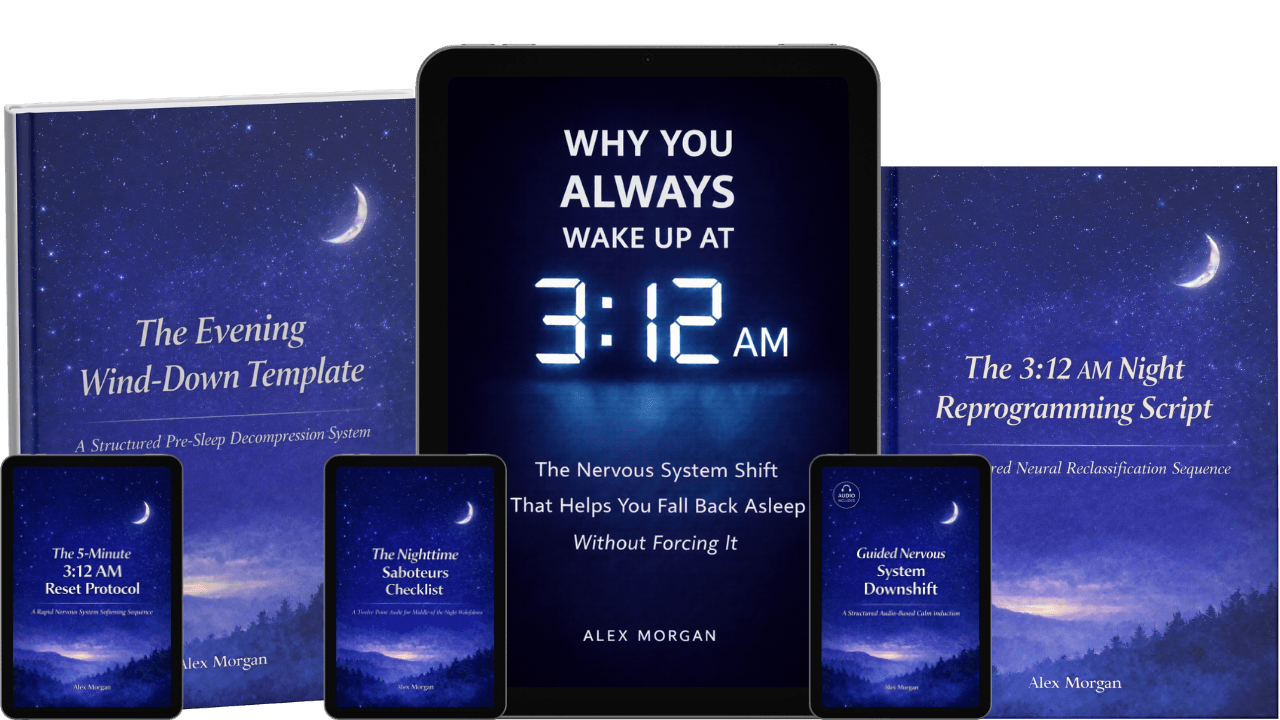
"Why You Always Wake Up At 3:12 AM" Follow The 14-Night Reset Plan
A complete, science-backed eBook written specifically for adults who experience chronic, recurring middle-of-the-night waking. Not general insomnia. Not trouble falling asleep. Just the very specific pattern of waking at the same hour every night.
If fixing your sleep was about going to bed earlier or avoiding screens, you would have fixed it by now. You're not looking for another evening routine tip or another "sleep hygiene 101" blog post recycled into a $37 course. You've seen all of those. You've tried most of them.
What you need is a guide that finally explains the actual mechanism behind what's happening to your body at 3 AM, and then gives you a precise, step-by-step toolkit to stop it.
We took the complex neuroscience of cortisol rhythms, HPA axis dysregulation, and nervous system threat response, and distilled it into plain, actionable English. Every chapter is structured around one question: what do you actually do right now, in this moment, to get back to sleep and prevent this from happening again tomorrow?
- The complete science of the Cortisol Shadow Effect™, explained in a way that will make you say "why has nobody ever told me this before?"
- The 5 categories of Nighttime Saboteurs, everyday habits, foods, thought patterns, and environmental triggers silently priming your 3 AM alarm call.
- The exact physiology of nervous system downshifting, how to move from sympathetic activation to parasympathetic dominance in under 5 minutes, with breath alone.
- How to rebuild your cortisol curve over 7 to 14 days, so the pre-dawn surge becomes a gentle signal instead of an alarm bell.
- The Evening Architecture Framework, a precision wind-down structure that primes your nervous system for deep sleep before you ever get into bed.
Plus 5 Powerful Bonuses, Yours Free
The exact same toolkit that has helped hundreds of chronic 3 AM wakers sleep through the night within 14 days. Included at no additional charge.
The 5-Minute 3:12 AM Reset Protocol
Your emergency toolkit for the nights when you wake up mid-sleep and need to get back under, fast. A precise, body-based sequence combining breath regulation, somatic grounding, and a targeted cognitive reframe designed to interrupt the sympathetic activation response before it fully locks in.
- A precise, step-by-step sequence you can execute in total darkness, half-asleep, without looking at your phone.
- A targeted breath ratio that activates the vagus nerve and triggers parasympathetic dominance within 90 seconds.
- A 60-second cognitive reframe script to neutralize the anxiety of waking up.
- A protocol so automatic that after a few nights, your body executes it before you're even fully conscious.
Guided Nervous System Downshift (Audio)
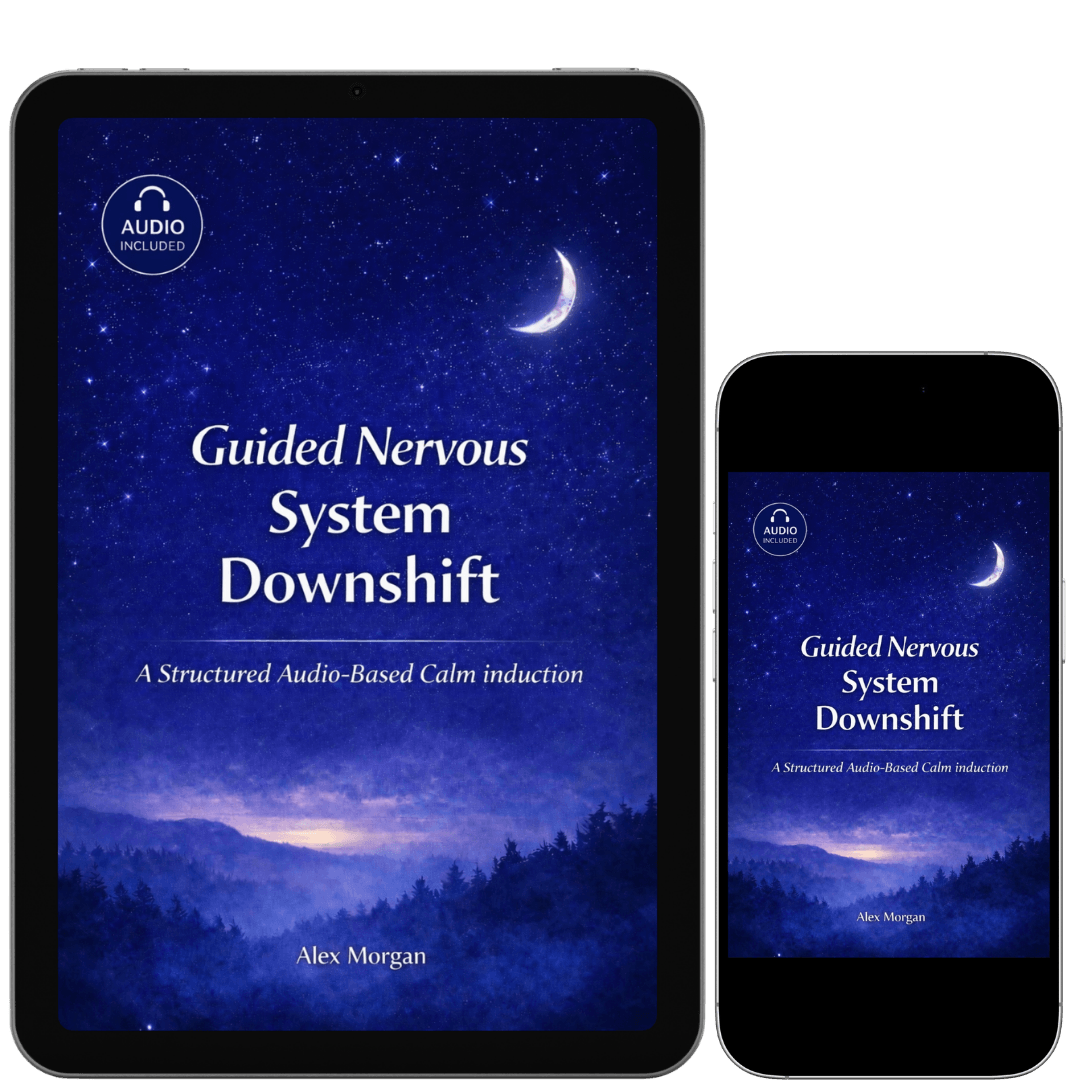
Knowledge isn't enough when you're lying awake at 3 AM with your heart pounding. This professionally guided audio takes you step by step through a full nervous system downshift, a structured sequence of breathwork, body scan, and vagal activation that moves your physiology from high-alert to deep-rest in real time.
- A fully guided 12-minute audio sequence designed specifically for the 2:30 to 4:30 AM cortisol window.
- Progressive muscle release and diaphragmatic breathing cues calibrated for the middle-of-the-night state.
- A custom sleep anchor phrase that conditions your nervous system to drop into rest on command.
- Professionally recorded for clarity and a deeply calming listening experience, even in total darkness.
The Nighttime Saboteurs Checklist
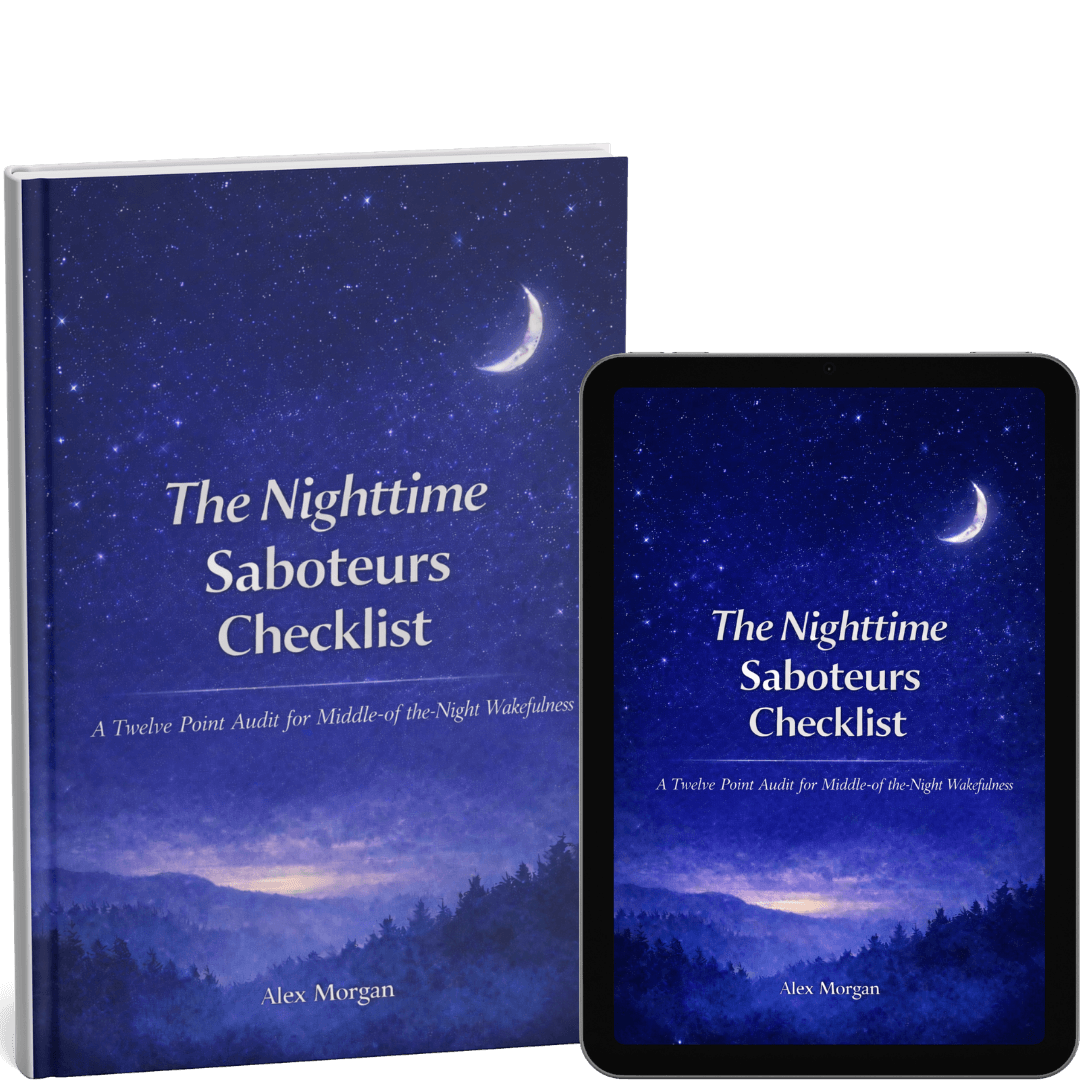
Most people waking up at 3 AM are unknowingly triggering their nervous system's alarm response hours before bed. This checklist maps every known Nighttime Saboteur across five categories: dietary, behavioral, digital, emotional, and environmental.
- A categorized checklist of 40+ documented Nighttime Saboteurs across five biological and behavioral categories.
- A simple scoring system that ranks your personal saboteur load and prioritizes which ones to eliminate first.
- A "Hidden Saboteurs" section covering the counterintuitive triggers most people never suspect.
- A weekly review template to track elimination progress and correlate it with sleep quality.
The Evening Wind-Down Template

The single most effective thing you can do to prevent a 3 AM wake-up is not what you do after you wake up. It's what you do in the 90 minutes before you go to bed. A precision-designed 12-minute evening protocol that creates a genuine neurological transition from active life to sleep-ready state.
- A precise 12-minute evening sequence that moves your nervous system into parasympathetic dominance before your head hits the pillow.
- A "cognitive offloading" technique that externalizes unfinished mental loops so your brain stops processing them at 3 AM.
- A physical environment checklist: the three room-condition variables that most commonly prime a cortisol-triggered wake-up.
- A simple emotional completion practice that clears accumulated "threat debt" from the day in under 3 minutes.
The 3:12 AM Night Reprogramming Script
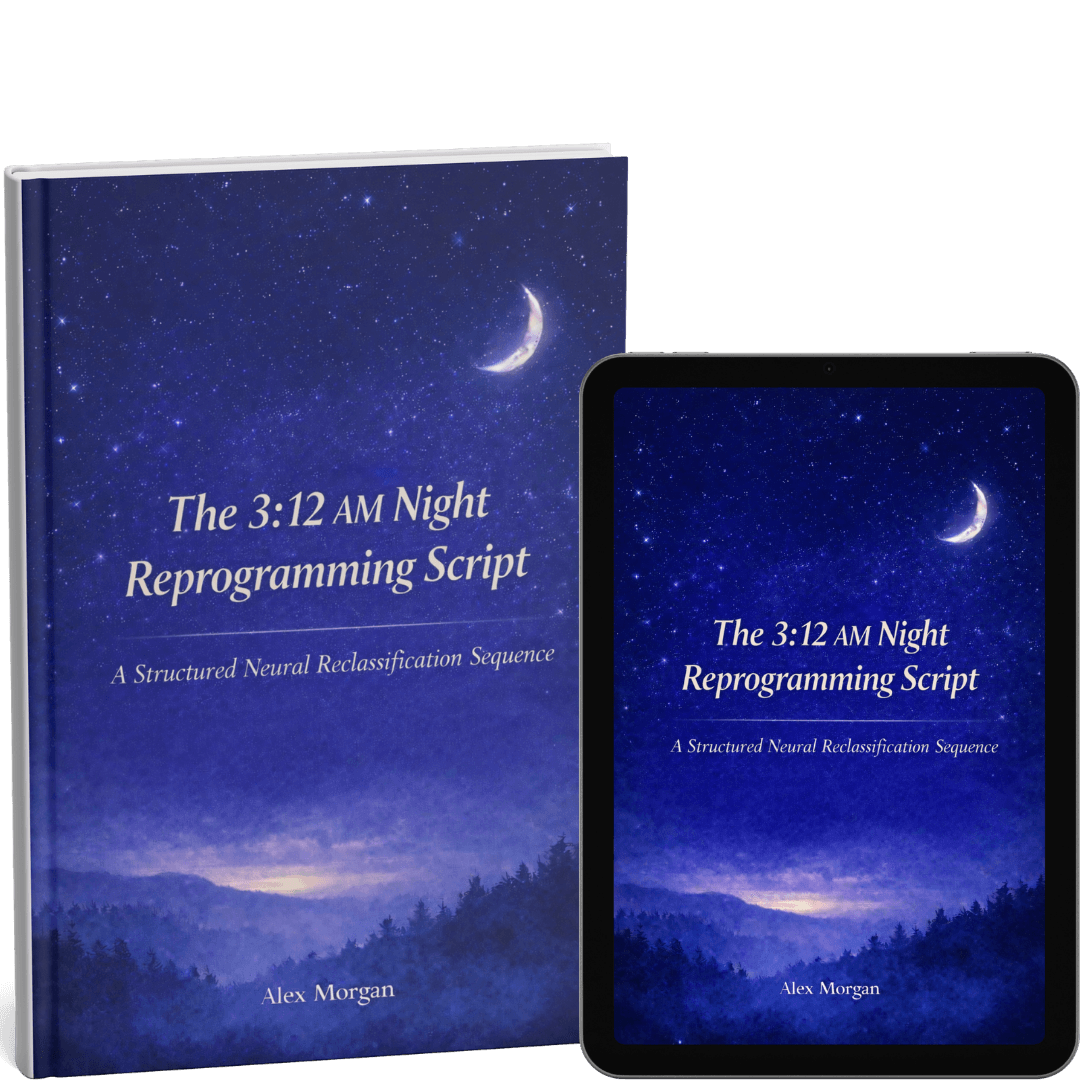
Over weeks and months of chronic 3 AM wake-ups, your brain has learned to associate that hour with anxiety, frustration, and dread. The Night Reprogramming Script is a targeted self-talk protocol designed to systematically dismantle that conditioned fear response and replace it with a new association: calm, neutrality, and safety.
- A 7-minute scripted mental protocol that dismantles the conditioned fear-of-waking response at its emotional root.
- A progressive exposure sequence that transforms 3 AM from a threat cue to a neutral and eventually positive anchor.
- A sleep-state affirmation sequence calibrated for the hypnagogic window for maximum neuroplastic impact.
- A 14-night implementation calendar with specific script variations for each phase of the process.

Real People. Real Sleep.
Here's Exactly What You'll Work Through Inside The 14-Night Protocol
Mapping Your Cortisol Shadow
Diagnostic: understand the exact biology of your specific wake-up pattern.
Before you change anything, you map what's actually happening in your body. This section walks you through the diurnal cortisol curve, the 2:30 to 4:00 AM pre-dawn surge, the HPA axis, and the polyvagal mechanism that turns a normal hormonal signal into a full wake-up. You leave this section with a concrete model of your own pattern and a baseline to measure against over the next 14 nights.
The Saboteur Audit
Identify the 5 daily triggers silently priming your nervous system.
A structured audit across five categories: dietary, behavioral, digital, emotional, and environmental. You'll score your personal "saboteur load" on a 40-point checklist, identify which three or four triggers are doing the most damage in your specific case, and walk away with a prioritized elimination plan. Most people identify at least one trigger they had absolutely no idea was contributing.
Threat Debt Reduction (Daytime Protocols)
Lower your baseline nervous system activation so 3 AM never has fuel.
Most "sleep advice" focuses on the evening. This protocol focuses on the 14 daytime hours that determine your baseline state. You'll learn specific daytime micro-practices, including the 90-second decompression resets, the post-lunch parasympathetic anchor, and the conversation-completion technique that stops unresolved emotional loops from accumulating into nighttime threat debt.
Evening Architecture
The pre-sleep wind-down structure that disarms the cortisol trigger.
A precision 12-minute protocol executed in the 90 minutes before bed. This is not "sleep hygiene." It's a structured neurological sequence: cognitive offloading, environmental calibration, breath ratio shift, and emotional completion. You'll get both a flexible template and a structured checklist version so the protocol fits whatever your evening actually looks like.
Real-Time Override
The 5-Minute Reset and Night Reprogramming Script for the wake-up itself.
For the nights you do wake up. The 5-Minute Reset Protocol works in total darkness, half-asleep, without your phone: a precise breath ratio, a somatic grounding sequence, and a 60-second cognitive reframe. Combined with the 14-Night Reprogramming Script, this is the layer that breaks the conditioned fear of waking and rewires your brain's association with 3 AM.
Maintenance & Long-Term Sleep Sovereignty
From "I fixed it" to "I never have to worry about this again."
A 30-day, 90-day, and yearly maintenance framework so the result holds. You'll learn how to recognize the early warning signs of cortisol drift before symptoms return, which two micro-practices to keep as non-negotiable, and how to recalibrate fast if a major life stressor (job change, loss, illness) ever tries to drag the pattern back. This is the part that turns a temporary fix into a permanent baseline.
Here's Everything You're Getting Today, At 82% Off
A complete nervous-system protocol delivered instantly, with every bonus included free.
- 📘 Why You Always Wake Up At 3:12 AM (Core eBook)$47
- 🎁 Bonus #1: The 5-Minute 3:12 AM Reset Protocol$17
- 🎁 Bonus #2: Guided Nervous System Downshift (Audio)$22
- 🎁 Bonus #3: The Nighttime Saboteurs Checklist$22
- 🎁 Bonus #4: The Evening Wind-Down Template$12
- 🎁 Bonus #5: The 3:12 AM Night Reprogramming Script$17
- Total Value$137
Hi, I'm Alex Morgan

For years, I dealt with the same middle-of-the-night wake-ups this guide is built around — falling asleep fine, then jolting awake around the same time, every night, with my mind already racing before I even opened my eyes.
Like most people, I tried the standard advice first: better sleep hygiene, melatonin, cutting caffeine, going to bed earlier. Some of it helped a little. None of it touched the actual pattern. So I started digging into why the body does this — specifically, why so many people who fall asleep normally wake up at almost the exact same hour, night after night.
What I found, reading through the research on cortisol rhythms and nervous system arousal, is that this pattern is well documented: it's connected to how the body's stress-response system behaves overnight, not to "bad sleep habits." The wake-up itself isn't the problem — it's the body treating a normal biological signal like a threat.
I put together everything that actually made a difference for me and for the people I later shared it with into this bundle — not as a clinical treatment, but as a practical, step-by-step way to work with your body instead of fighting it at 3 AM.
Frequently Asked Questions
Because most sleep solutions on the market target sleep onset or environment, not what happens overnight. Melatonin helps you fall asleep. Magnesium supports muscular relaxation. Sleep hygiene addresses your environment. This guide focuses specifically on the pre-dawn cortisol window and how your nervous system responds to it, which is a different piece of the puzzle than the one most sleep advice covers. That's why it can help even after those other approaches haven't.
Absolutely. "3:12 AM" is shorthand for the biological window between approximately 2:30 and 4:00 AM when the pre-dawn cortisol surge occurs in most people. If you wake up anywhere in that window (2:47, 3:12, 3:28, 3:51), this guide is written precisely for you. The exact minute varies by individual circadian phase. The underlying mechanism is the same.
It varies from person to person, since everyone's nervous system responds a little differently. Some people notice a difference with the 5-Minute Reset Protocol (Bonus #1) the first time they try it, on the night they wake up. Others need a few nights of the full routine before they notice a real shift. Most people who follow the 14-night plan consistently start to notice changes within that window, which is part of why the guarantee covers a full 14 days: it gives your body enough time to respond.
No. While the Nighttime Saboteurs Checklist will likely identify some habits contributing to your pattern (and eliminating those accelerates results), the core protocol does not require you to overhaul your life. No elimination diet. No mandatory exercise. No rigid bedtime. The method works within your existing schedule. The Evening Wind-Down takes 12 minutes. The Reset Protocol takes 5. The adjustments are targeted, not total.
Yes, this guide was written specifically for you. Most sleep resources address insomnia broadly. This guide focuses exclusively on middle-of-the-night waking in the pre-dawn cortisol window. If you fall asleep easily but wake at 3 AM and can't return to sleep, you are the exact target. The fact that you fall asleep easily is actually a positive indicator: your sleep architecture is intact. The problem is the cortisol trigger.
The guide is built around well-documented concepts in sleep and stress physiology: circadian cortisol rhythms, the body's stress-response (HPA axis) activity, and nervous system regulation. These are established areas of research, and you can find plenty of it if you search for pre-dawn cortisol and nighttime awakenings. What this guide does is bring those ideas together into a plain-English, step-by-step approach you can actually use, rather than leaving them scattered across academic papers. It's an educational resource, not a clinical treatment or a substitute for medical advice.
Then you pay nothing. Use the full bundle for 14 nights. If you don't notice measurable improvement in how often you wake up, or in how quickly you return to sleep when you do wake, send one email to support within 14 days of purchase and we refund every penny. No forms. No "did you really try it?" interrogation. The only thing you risk is another week of broken sleep.
Instantly. As soon as your checkout is complete, you'll be redirected to a private access page where the eBook and all five bonuses are available for immediate download. You can save them to phone, tablet, laptop, desktop. The guided audio (Bonus #2) downloads to any podcast app or audio player, so it's ready on your bedside device even when your phone is on Do Not Disturb.